Why On-Premises AI is the Future of Compute for Small Businesses
How smart small businesses are protecting themselves from AI market volatility while gaining competitive advantages through local compute infrastructure
The Shift to Local AI Infrastructure
As artificial intelligence becomes central to business operations, forward-thinking organizations are moving beyond cloud-dependent solutions to embrace on-premises AI infrastructure. This shift represents more than just a technology choice—it's a strategic decision to maintain control, reduce costs, and protect against market uncertainties.
While cloud AI services like ChatGPT and Claude have democratized access to artificial intelligence, they've also created new dependencies and risks that savvy businesses are beginning to recognize and address proactively.
Access to Frontier Open Source Models
One of the most compelling advantages of local AI deployment is access to near-frontier open source models that rival proprietary cloud offerings. Models like Llama 3.1 405B, Qwen 2.5, and Mixtral provide performance comparable to GPT-4 and Claude-3, but without the recurring costs and data privacy concerns.
"The cloud can scale and at a short-term cost point that works really well, but as soon as you leave stuff there, [including] the data itself, you've got to pay for that. It becomes a cost argument quite quickly." — Grant Caley, UK and Ireland Solutions Director, NetApp
Unlike cloud services that limit model choice, on-premises deployment allows businesses to select and switch between different models based on specific use cases, optimizing both performance and costs for each application.
Protection Against Market Volatility
Cloud AI services expose businesses to several market risks that on-premises solutions eliminate entirely:
Price Volatility
AI service providers can increase prices without warning. OpenAI has already implemented multiple pricing changes, and as demand grows, costs are likely to rise further. On-premises AI provides predictable, controlled costs.
Per-Seat Cost Scaling
Cloud AI providers charge $50-100/month per user regardless of actual usage. A 100-person company pays $5,000-10,000/month ($60,000-120,000/year) even if only 20% actively use AI tools. On-premises AI eliminates this "user tax" entirely—costs scale with performance needs, not headcount.
Service Degradation
To manage costs and capacity, providers may silently downgrade model capabilities or route requests to inferior models during peak times. This "model rerouting" can significantly impact business operations without user awareness.
Unexpected Downtime
Cloud AI services experience regular outages that can halt business operations. ChatGPT, Claude, and other services have all experienced significant downtime that affected millions of users simultaneously.
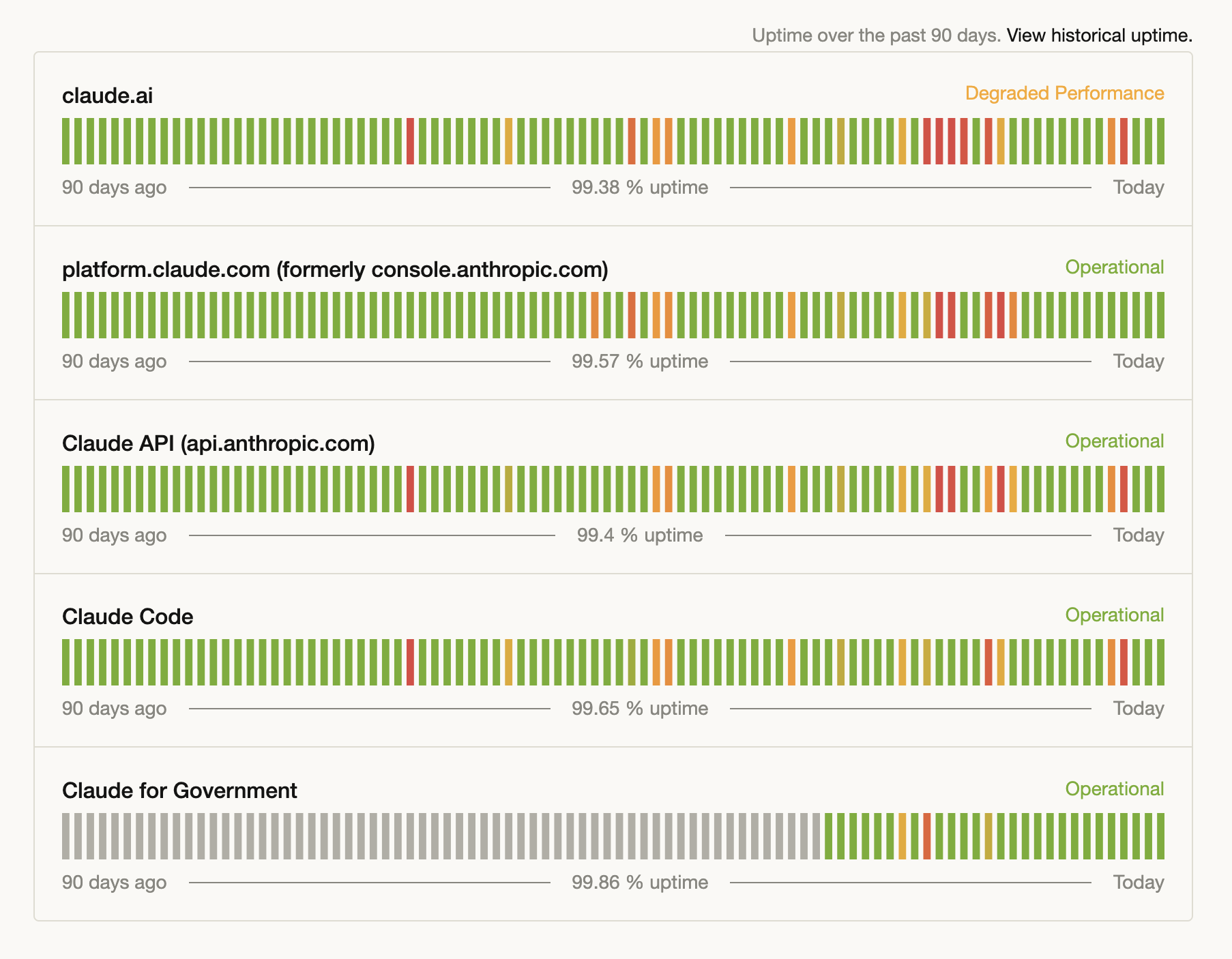
Real-world uptime data showing the reliability challenges of cloud AI services, with frequent performance degradations and outages that can disrupt business operations.
Infrastructure Constraints and Market Pricing
The global AI infrastructure is facing unprecedented challenges that will likely drive costs higher and reduce availability:
The $6.7 trillion investment requirement reveals a fundamental challenge: this level of infrastructure spending is likely unattainable, creating a massive supply-demand imbalance that will drive cloud AI costs dramatically higher. As McKinsey analysis shows, the scale of required investment far exceeds realistic market capacity, meaning cloud AI providers will be forced to ration capacity and increase prices significantly to manage demand.
This economic reality makes on-premises AI not just cost-effective, but essential for small businesses that want to avoid being priced out of AI capabilities entirely. By investing in local infrastructure now, businesses can secure their AI future before cloud costs become prohibitive.
Unmatched Privacy and Security
"Some of the primary challenges that organisations wrestle with are data privacy and sovereignty. This is especially critical in sectors such as defence, nuclear, healthcare and other highly regulated organisations that need robust control over data." — Derreck van Gelderen, Head of AI Strategy, PA Consulting
Data privacy concerns with cloud AI services continue to grow as businesses realize their sensitive information is being used to train and improve external models. Recent investigations have revealed that major AI providers analyze user inputs for various purposes, creating compliance and competitive risks.
Complete Data Control
Your data never leaves your premises, ensuring complete privacy and compliance with regulations like GDPR, HIPAA, and industry-specific requirements.
No Third-Party Access
Eliminate the risk of data breaches, unauthorized access, or inadvertent data sharing that comes with cloud AI services.
Superior Performance and Reliability
On-premises AI infrastructure offers performance advantages that cloud services cannot match:
Internet-Independent Operation
Local AI continues working during internet outages, ensuring business continuity even during connectivity issues that would halt cloud-dependent operations.
Consistent Low Latency
Local processing eliminates network latency and provides consistent response times, regardless of internet congestion or geographical distance to cloud servers.
Dedicated Resources
Unlike shared cloud infrastructure, on-premises AI provides guaranteed compute resources without competition from other users or workloads.
"Latency is another concern, particularly for applications requiring real-time or low-latency responses, such as autonomous systems or edge-based solutions. Delays introduced by transmitting data to and from cloud servers can be a limiting factor." — Derreck van Gelderen, Head of AI Strategy, PA Consulting
Flexibility and Cost Control
Perhaps the most underappreciated advantage of local AI is the ability to switch models without incurring additional subscription costs. Businesses can:
- Load specialized models for different tasks (coding, writing, analysis, translation) without paying for multiple subscriptions
- Experiment with new models as they're released, staying at the cutting edge without vendor lock-in
- Optimize for specific use cases by fine-tuning models on proprietary data, creating competitive advantages
- Scale efficiently by adding hardware capacity only when needed, rather than paying for unused cloud credits
- Schedule automated tasks during off-hours to run data analysis, content generation, and processing routines, adding thousands of dollars in "free compute" value by fully utilizing hardware 24/7
- Long amortization period allows companies to recycle hardware for different models or repurpose for entirely different computing needs, maximizing return on investment
"Putting things back into the datacentre is a good thing to do from a cost profile, particularly if they [the models] are going to be running all the time." — Grant Caley, UK and Ireland Solutions Director, NetApp
The Strategic Advantage
As AI becomes increasingly critical to business operations, companies that maintain control over their AI infrastructure will have significant advantages over those dependent on external services. On-premises AI deployment provides:
Economic Benefits
- Predictable, controlled costs
- No subscription dependencies
- Hardware ownership and depreciation benefits
- Elimination of data transfer costs
Strategic Benefits
- Complete technological independence
- Proprietary AI capabilities
- Competitive data advantages
- Future-proof infrastructure investment
The businesses that recognize this trend early and invest in on-premises AI infrastructure will be better positioned to compete in an increasingly AI-driven economy, while those that remain dependent on cloud services may find themselves at a significant disadvantage as market conditions change.
Making the Transition
The shift to on-premises AI doesn't require massive infrastructure investments or technical expertise. Modern solutions like Faraday Machines provide enterprise-ready AI infrastructure that can be deployed quickly and scaled as needed, offering all the benefits of local AI deployment without the complexity traditionally associated with on-premises solutions.
For forward-thinking businesses, the question isn't whether to adopt AI—it's whether to maintain control over that adoption. On-premises AI infrastructure ensures that businesses can harness artificial intelligence's transformative power while maintaining the independence, security, and cost control essential for long-term success.
References
[1] Computer Weekly. (2024). "Why run AI on-premise?" Available at: https://www.computerweekly.com/feature/Why-run-AI-on-premise
[2] Grant Caley, UK and Ireland Solutions Director, NetApp. Interview with Computer Weekly, 2024.
[3] Derreck van Gelderen, Head of AI Strategy, PA Consulting. Interview with Computer Weekly, 2024.
[4] McKinsey & Company. (2024). "The cost of compute: A $7 trillion race to scale data centers." Available at: https://www.mckinsey.com/industries/technology-media-and-telecommunications/our-insights/the-cost-of-compute-a-7-trillion-dollar-race-to-scale-data-centers
[5] NetApp Blog. (2024). "Sovereign cloud solutions for secure data control."
[6] PA Consulting. (2024). "AI in 2026: How organisations will change as they continue to embed and scale."
Ready to Control Your AI Future?
Join forward-thinking organizations that have chosen independence over dependency. Discover how on-premises AI can transform your business while protecting your data and controlling your costs.
Schedule Consultation